Food Vendors Guide to festivals
A Food Vendors Guide to the Festival Circuit
It's not all "party on !!"
For many independent food truck owners, the festival circuit appears to be the ultimate dream. A captive audience of thousands, a vibrant atmosphere, and the potential for a weekend of record-breaking sales.
But before you invest all your eggs in a shiny new truck - here are a few home truths you should know.
Success at a busy festival has little to do with having the most artisanal, gourmet food offer and more about being a resilient, and incredibly well-prepared operator
Your Customer Is Not Who You Think They Are
This is the most important lesson for any caterer new to festivals. In a city-centre lunch market, your customer might be a discerning foodie looking for a unique culinary experience. At a multi-day music festival, your customer is more likely to be tired, sunburnt, heavily intoxicated, and desperate for something hot, fast, and easy to eat while stumbling back to a tent.
We have seen countless beautiful food trucks with stunning, high-quality menus fail at major festivals because they misunderstand this fundamental truth. When a festival-goer has been on a weekend-long bender, their priorities are not complex flavour profiles or delicate presentation. They are:
Speed - Long queues are a killer - If you don't get your food out in minutes, you will lose customers to the faster burger van next door- even if your food is better.
Convenience - Can it be eaten with one hand, whilst holding a drink with the other- does it require a knife and fork and a place to sit down- Simple formats - *wraps, burgers, chips, food in a pot will always outsell.
Satisfaction - Your food needs to satisfy a craving- Hot, salty and cheesey are popular for a reason.
Simplicity - Is your menu easy to read and understand? - too complicated, or confusing, your punter won't embarrass themselves or ordering the wrong item.
Ask a festivalgoer a week later what they ate, and they are unlikely to remember the “top quality” ingredients. They will remember if it was hot, if it filled a hole, and if they had to wait 45 minutes to get it. Your operational efficiency is your most valuable asset.
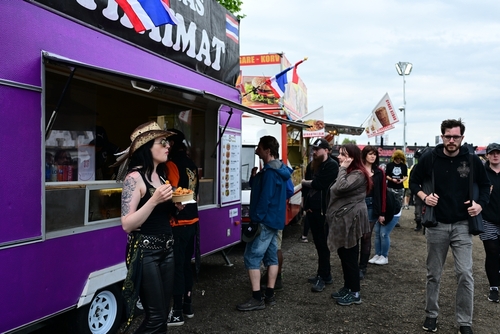
Your Stall - Is it eye catching ?? - a nice shiny food truck at a food fair is one thing, but in a festival you need something big and colourful. There is a reason why the big successful food vendors will erect scaffolding with colourful painted imagery and signage. If your operation is a simple blackboard or a glossy sign, that looks great in a carpark, it will look tony in a big field, so think about that too.
The Brutal Economics of a Festival Pitch
The potential for high revenue at a festival is matched by incredibly high costs and risks. Before you even think about your menu, you need to do the maths. An event caterer’s finances are stretched far thinner than a typical restaurant.
As a general rule, a sustainable pitch fee should be around 15-20% of your projected turnover. If an organizer is asking for more, you are taking on a significant financial risk. so break it all down before you take the risk.
remember - Pitch fee, Food and packaging, staff wages
so, Pitch fee - 15% of turnover
Food cost & packaging - 35%
Staff wages - 25%
If you are VAT registered check that the Pitch fee is based on net turnover not Gross..
So even if you are super quick, the best you will get is 25% of turnover - if everything goes perfectly.
This doesn’t even include your transport, insurance, vehicle maintenance, or the cost of power and water on site, which can run into hundreds of pounds. The dream of a £10,000 weekend can quickly evaporate if you haven’t accounted for every single expense.
Your Pre-Festival Checklist: Due Diligence is Everything
Never sign a contract or pay a deposit without getting clear answers to some critical questions. An organizer who is unwilling to provide this information is a major red flag.
·What are the real attendance figures? Ask for data from the last few years, not just optimistic projections.
·How many tickets have been sold so far?
·How many other food traders will be there - Crucially, what type of food are they selling?
·What is the audience demographic? A folk festival will have a very different customer base and spending habits than a heavy metal festival.
·Where exactly is my pitch located? A spot with high footfall near a main stage or bar is worth far more than a pitch hidden away by the toilets.
·Ask for a site map and be prepared to negotiate on price based on location.
The Operational Grind
Being a successful festival caterer is about being a robust, self-sufficient operator. Your food is only part of the equation. You need to be prepared for:
•The Paperwork: You will need, at a minimum, a high food hygiene rating, comprehensive public liability insurance (often £5M-£10M), risk assessments (HACCP, fire), and PAT testing certificates for all your electrical gear.
•The Logistics: You need to be entirely self-contained. This includes bringing enough staff (and planning for their passes and accommodation), managing your own water and waste according to site rules, and ensuring you have the correct power hook-up (and have paid for it).
•The Stamina: Festival trading is a marathon, not a sprint. It involves long hours, physically demanding work, and often, sleeping in a tent or caravan for a week.
Venturing into the festival circuit can be a hugely rewarding experience, but it demands a shift in mindset. Prioritise operational efficiency, understand your real customer, do your financial homework, and be prepared for the relentless operational grind. It’s the smart, resilient, and adaptable operators—not always the most gourmet ones who truly succeed in the field.
